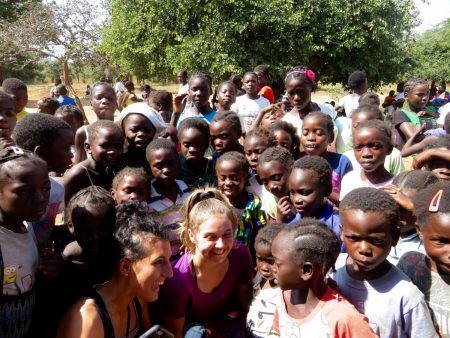
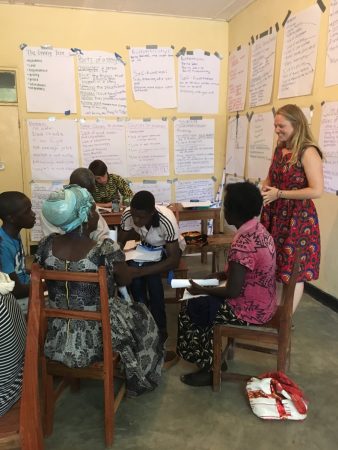
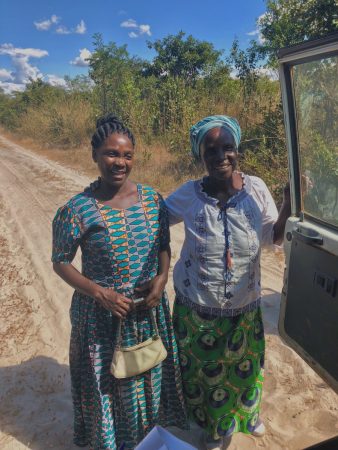
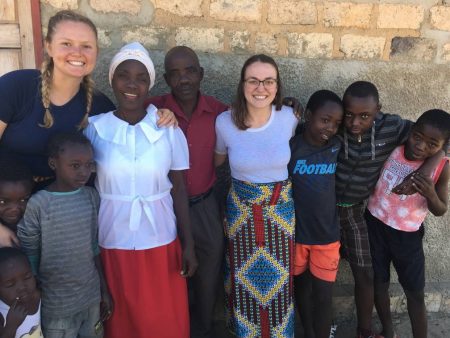
Sanna (left) and Madelyn share a laugh with some of the youth we met during last weekend’s visit to Dipalata.
“What time is it? What time is it?” This is the question I constantly asked myself before coming to Zambezi. It is as if time is the commodity that our lives function by.
Something I have come to admire about Zambians is their view of time. They don’t put emphasis on being on-time, and there seems to be no such thing as being “late” in Zambia. Last Thursday Mama Love and her husband Duncan visited us for dinner at the convent. I remember Jeff saying at breakfast earlier that day, “Please be back at 18:00 hours for dinner, which will probably not begin until 19:00 hours.” Food wasn’t actually served ‘til 19:30. During our weekend trip to Dipalata last weekend, we woke up Sunday morning for church at 9:30. But breakfast was still being prepared at the time the service was supposed to begin, so the entire community willingly waited for us to finish our meal to start mass. Even businesses don’t run on a set schedule. A couple of our students, Alex and Wilfred, close their tailor shop every day from 10:00-11:00 the past couple weeks so they can attend our computer class. The fluidity of time engulfs itself in the Zambian culture.
Nothing begins “on-time” and nothing ends “on-time.” I kind of love it.
Even a trip to the market is always longer than expected. It usually goes something like this: we leave the convent and encounter many smiling children who stand under the warmth of the sun waiting to greet us. We exchange handshakes and hugs and maybe even teach them some songs (their favorite is “Boom Chicka Boom!”). The kids may teach us some words in the Lunda language, as others laugh about our poor pronunciation. Then we continue on our walk to the market, down the familiar dirt road, usually accompanied by a few young Zambian children who reach to hold our hands. We may run into some of our students, maybe our dear friend Moses or Peter, and strike a humble conversation about their appreciation for their mother’s hard work at home, or how much they value the education they are able to receive through our classes. We part ways after some time and soon round the last corner of our path that will lead us to our destination. The fishy smells we sniff, the bright fabrics we pass by, the wide smiles we encounter, all these allow us the opportunity to pause and ask questions, to take a moment to wonder about the beautiful culture we have been introduced to for the past thirteen days.
Then we may reach our intended destination of George’s market some 53 minutes later.
Every day I learn more about what it means to understand Zambia. Our relationship with our Zambian friends is not dependent on whether or not we are on-time to meet with them or fitting as many meaningful experiences into our daily schedule as possible. Our time in Zambia is about slowing down, asking questions, being in the moment, and getting to know the people who’ve welcomed us here.
Something I have found so beautiful is how willing people are to share their personal stories: Mama Violet sharing with me the story of her first-born’s birth, Jacob speaking about how he works long hours so that he can give back to the family that gave everything to him despite their impoverished circumstances. No one holds back their stories, and that is what I have come to appreciate so much. It goes deeper than just asking “Musana Mwane, munayoyo mwane? Good afternoon, how are you?” Taking the time to hear these stories has helped me to focus on building intentional and meaningful relationships with the people I have met here, thinking of time as more than just four digits on a watch.
But I am still struggling how to bring back these ideas and thoughts back home and incorporate them into my day-to-day life back home. I have been cultured to always be cognizant of other people’s time. Being late is considered inconsiderate of others’ time. Our daily schedules are structured around time. We want to make sure every hour of the day is filled with some activity. I am learning to ignore the hours and minutes, and instead embrace the experiences as they come.
Back home, we are constantly thinking about the next place we have to be, the next test we have to study for, the next meal we have to eat and who will accompany us. I am so used to stressing about being on time to everything back home that I have realized I commonly forget about the importance of stopping and having conversations with those around me, to hear how their day is going, how their families are, how their classes were. Since being here, I have been inspired to dig deeper than those superficial conversations we feel so obligated to have in order to be more intentional with the relationships I have back at home.
Kisu Mwane,
Sanna Darvish ‘20
P.S. to Mom, Dad, Maleka and Del, I miss you lots and cannot wait to give you the biggest hugs in two short weeks. I am healthy, joyful, and excited to share my stories with you and the rest of the family and friends back home. Mom, you should know that I am taking all the probiotics you sent me with and I have been eating relatively well. I even got gifted a bag of quinoa so you could say I am living high. Maleka, I am so proud of you for finishing your last few weeks of high school, I cannot wait to come home and celebrate all your accomplishments.
P.S.S. I am sad to announce that we lost the annual Zam City Soccer match today after penalty kicks. Sorry to let all you Zambezi alums down. But Jeff Dodd did fashion his knee-high hot pink socks so I’d say it was a win.
P.S.S.S. We are having some challenges with the local data network. This has caused some delays in our posts. If it keeps up, Jeff has promised to climb to the top of the nearest tall tree, holding his phone up to the sky and gesturing wildly.
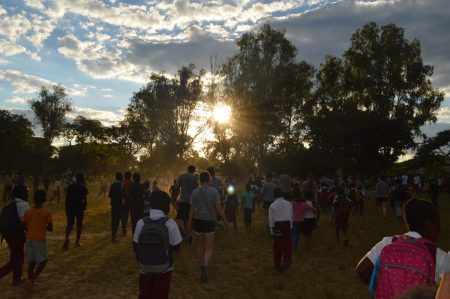
Despite our loss to ZamCity FC’s under 13 football team, we were still able to enjoy another beautiful Zambezi evening. Photo credit to Margarett Qaqish.



 Zambezi is more beautiful than I could have ever expected. I have already experienced so many things for the first time.